For brands, distributors, law-enforcement agencies, and military procurers, a holster is far more than an accessory. It serves as the critical interface between the user, the firearm, and the mission. As a holster manufacturer since 2009, we have produced thousands of duty, tactical, and concealed-carry holsters for clients worldwide.
This guide offers a clear, technical overview of holster types, retention systems, materials, manufacturing processes, and key considerations when sourcing custom OEM solutions.
Holster Typology: Design by Application and Carry Method
The primary way to classify a holster is by how and where it is carried, because this directly determines its shape, mounting hardware, and performance requirements.
1. Outside-the-Waistband (OWB) Holsters
These mount on the exterior of the belt. They provide excellent stability and a fast, repeatable draw stroke. OWB designs are the standard choice for uniformed duty holsters used by law enforcement and military personnel, as well as for open-carry and competition applications.
Most duty-grade OWB holsters incorporate active retention systems and are built to work with specific belt-mount platforms such as Safariland MLS or Tek-Lok.
2. Inside-the-Waistband (IWB) Holsters
These sit inside the waistband and are secured by a clip or loop. Their main purpose is concealment. IWB holsters dominate the civilian concealed-carry (CCW) market and include specialized variants such as Appendix Inside-the-Waistband (AIWB) designs.
When producing IWB holsters, manufacturers pay close attention to comfort features—rounded edges, full sweat guards, claws or wings, and wedges—to minimize printing and improve all-day wearability.
3. Drop-Leg and Thigh Rigs
A drop-leg holster is mounted on a platform strapped to the thigh. This lowers the firearm so it clears body armor, load-bearing vests, or vehicle seats.
These rigs are widely used by military, SWAT, and special operations units, as well as in certain competitive shooting sports. The platform’s strapping system is as important as the holster shell itself; it must be fully adjustable, quick to don, and remain stable under heavy movement.
4. Shoulder Holsters and Specialty Carries
Shoulder holsters use a harness worn under the arm and allow the firearm to be carried concealed under a jacket or while seated for long periods. They remain popular with plainclothes officers, pilots, and drivers.
Other niche designs include pocket holsters, ankle holsters, and vehicle-mounted systems, each developed to meet very specific operational or concealment needs.
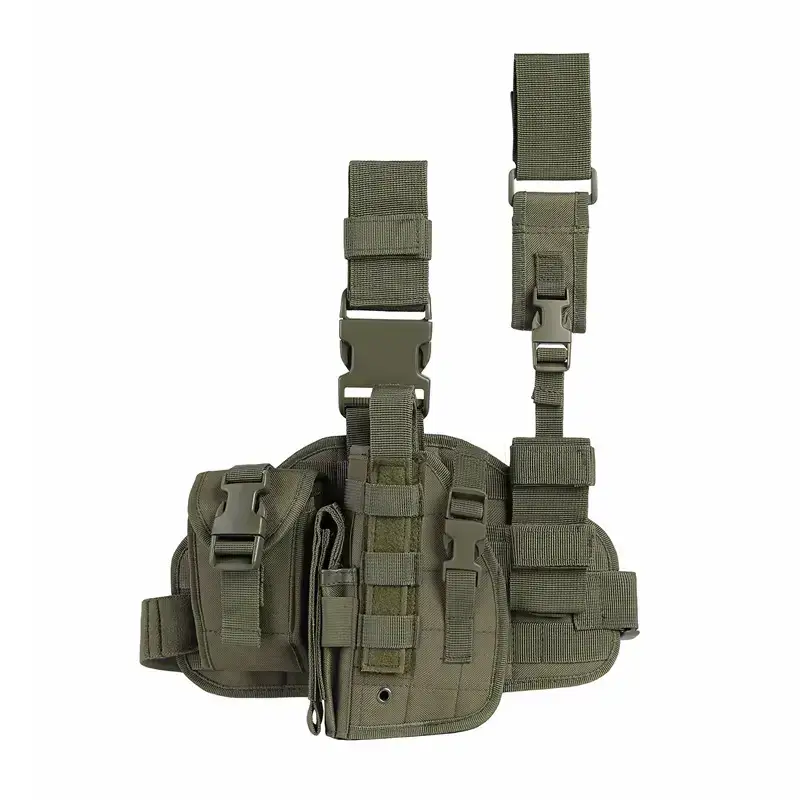 OD green tactical drop leg holster
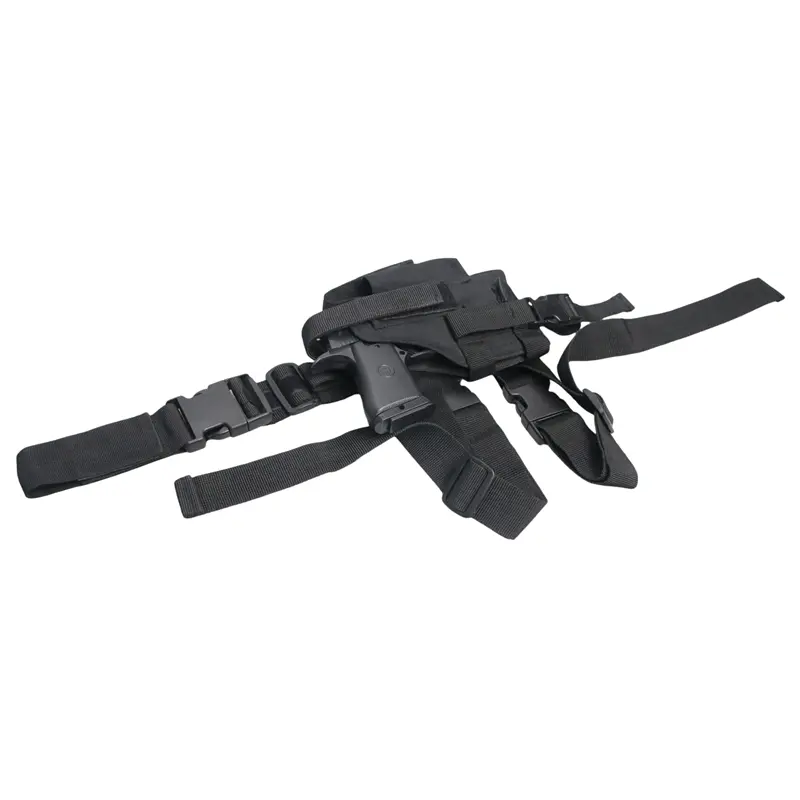 Black Tactical Thigh Holster with pistol
Holster Retention Levels: From Passive Friction to Active Security
Retention describes the amount of force or deliberate action required to remove the firearm from the holster. Most manufacturers reference a tiered system that originated with Safariland’s classification, although exact definitions can vary.
- Level I (Passive Retention) – The firearm is held by friction, a molded trigger-guard lock, or a simple thumb break. This level is common in most civilian and CCW holsters.
- Level II (One Active Retention Device) – The user must perform one deliberate action (for example, releasing an ALS hood or thumb break) before drawing. This is the minimum requirement for many law-enforcement duty holsters.
- Level III (Two or More Independent Active Devices) – Two separate actions are required. These holsters are specified for high-risk environments.
Higher retention levels add parts, increase manufacturing complexity, and raise cost. They also require more rigorous in-house testing to guarantee consistent performance.
For Safariland’s current definitions based on the number of hand movements required, see their official retention guide.
Material Selection for OEM Projects: Performance Trade-offs
Material choice determines weight, durability, weather resistance, cost, and the manufacturing method required.
| Material | Key Advantages | OEM Considerations | Melhor para |
| Kydex/Thermoplastics | Offer excellent retention memory, are fully waterproof, and require almost no maintenance. | Requires precision molding for each firearm model. Easy to modify with heat for custom fits. | Duty holsters, tactical holsters, high-volume IWB/OWB holsters. |
| Couro | Provides a classic appearance, conforms to the firearm over time, and produces a quiet draw. | Requires skilled handcrafting, periodic conditioning, and is more sensitive to moisture. | Traditional OWB, shoulder, and revolver holsters. |
| Nylon / Fabric | Lightweight, low-cost, and flexible. | Retention is less precise, and the material can collapse when the firearm is removed. | Universal fit holsters, low-profile IWB, budget lines. |
| Hybrid (e.g., Kydex + Leather) | Combine a rigid Kydex or polymer shell with a leather, neoprene, or fabric backing for comfort. | Two-material assembly increases steps and requires careful bonding to prevent delamination. | Comfort-focused IWB/OWB concealed carry. |
The Custom Holster OEM/ODM Process: From Concept to Delivery
Partnering with a professional gun holster supplier for a custom project follows a structured path.
- Phase 1 – Discovery & Specification
We collect the exact firearm models (including lights, optics, or other attachments), target annual volume, price target, required retention level, mounting hardware, color options, and branding requirements.
- Phase 2 – Design & Prototyping
CAD models are created, followed by 3D-printed or hand-formed prototypes. Fit, draw stroke, and retention are tested on the actual firearm.
- Phase 3 – Tooling, Pilot Run & Full Production
Molds or patterns are produced. A small pilot batch is manufactured and approved before full production begins. In-line quality checks monitor retention tension, hardware torque, stitching integrity, and finish.
- Phase 4 – Packaging, Branding & Logistics
Custom logos, tags, and compliance labels are applied. We handle export documentation, freight forwarding, and any required certifications.
Integration of Holsters with Broader Gear Systems
A holster rarely exists in isolation. Our clients often require holsters that work seamlessly with suportes de placas, chest rigs, duty beltse bolsas modulares. We routinely design mounting interfaces that are fully compatible with MOLLE, PALS, and quick-release systems.
Because we also manufacture vests, belts, pouches, and slings in-house, we can deliver complete, color-matched, and functionally integrated kits from a single source—reducing lead times and ensuring perfect compatibility.
Sourcing Checklist for Brands and Procurement Teams
When requesting a quote from a tactical holster manufacturer, please provide:
- Firearm Specification Sheet: List of exact models, including accessory compatibility (e.g., “For Glock 19 with Streamlight TLR-7A”).
- Annual Forecast Volume: Key for determining MOQ and unit cost.
- Compliance Requirements: Any necessary testing standards (e.g., drop tests, retention force tests).
- Branding & Packaging Details: Vector artwork, label requirements.
- Target Launch Timeline: Including buffer for prototyping and shipping.
Conclusion: Partnering with a Reliable Holster Manufacturer
A holster is a safety-critical component. Its design, materials, and construction must perform reliably under stress. For brands entering the market or agencies refreshing their kit, the choice between sourcing stock designs and investing in a custom OEM project hinges on differentiation, precise need, and volume.
Since 2009, we have specialized in translating technical and commercial requirements into production-ready holsters—delivered on time, on specification, and at competitive cost. We welcome inquiries from brands, distributors, and agencies ready to develop or source reliable duty holsters, tactical holsters, and concealed-carry solutions.
Contactar a nossa equipa to discuss your project, request samples from our existing molds, or start a custom development consultation. We look forward to supporting your next program.