Sourcing a manufacturer in China offers big advantages in capability, cost, and scale for tactical gear brands. However, the process involves navigating a complex landscape to find a truly reliable partner, not just the lowest bidder.
This guide provides a step-by-step, practical framework to help you identify and vet professional tactical backpack manufacturers with the expertise to execute your product vision.
The goal is to move beyond basic online searches and establish a partnership based on transparency, technical capability, and quality assurance.
Steps to Source a Tactical Backpack Manufacturer in China
Step 1: Define Your Project with Precision
Before contacting any supplier, internal clarity is your greatest asset. A well-defined project attracts serious manufacturers and enables accurate comparisons.
- Develop a Technical Pack: Create a detailed document containing technical drawings (CAD flats are ideal), dimensions, bill of materials (BOM), and stitch/construction notes. This “tech pack” is the universal language for manufacturers and reduces costly misunderstandings.
- Establish Your Standards: Determine your quality benchmarks. Are you targeting commercial durability or true mil-spec compliance? Reference existing standards like the TT-0010A Technical Specification for tactical soft goods to define your requirements objectively.
- Plan for Realistic Timelines and Costs: Understand that a proper development cycle includes prototyping and testing. Allocate realistic time and budget for 2-3 sample iterations before mass production approval.
Step 2: Understand the Manufacturing Landscape
China’s manufacturing is regionally specialized. Knowing where to look aligns your project with the right industrial ecosystem.
- Guangdong Province (Guangzhou, Dongguan, Shenzhen): This hub is known for advanced technical manufacturing, complex bag construction, and access to innovative materials and hardware. Factories here often excel at high-volume production with integrated R&D.
- Fujian Province (Quanzhou, Jinjiang): A long-standing center for sports, outdoor, and durable goods, with a strong foundation in nylon textiles and weaving. This region is often proficient in producing robust, functional packs and has a deep supply chain for related materials.
The Key Insight: Specialization often matters more than location alone. A manufacturer’s proven experience with products—whether minimalist assault packs or complex modular hiking systems—is a stronger indicator of success than its postal code.
Step 3: Employ Effective Sourcing and Vetting Channels
Move beyond simple keyword searches. A multi-channel approach yields better candidates.
- B2B Platforms with Critical Evaluation: While platforms like Alibaba are a starting point, use them strategically. Filter for “Verified Suppliers” with on-site check videos. Examzine factory photos for organized production lines and specialized equipment (e.g., bartack machines, laser cutters). Read transaction reviews carefully.
- Industry-Specific Trade Shows: Events like the 캔톤 페어 (Phase 3: Home & Textiles) or Asia Outdoor Show allow you to meet manufacturers in person, assess product quality firsthand, and have technical discussions.
- The Initial Communication Test: Your first inquiry is a test. Provide a brief project summary and tech pack. A professional manufacturer will ask specific questions about materials, construction, and volumes. A generic, instant price quote without questions is a significant red flag.
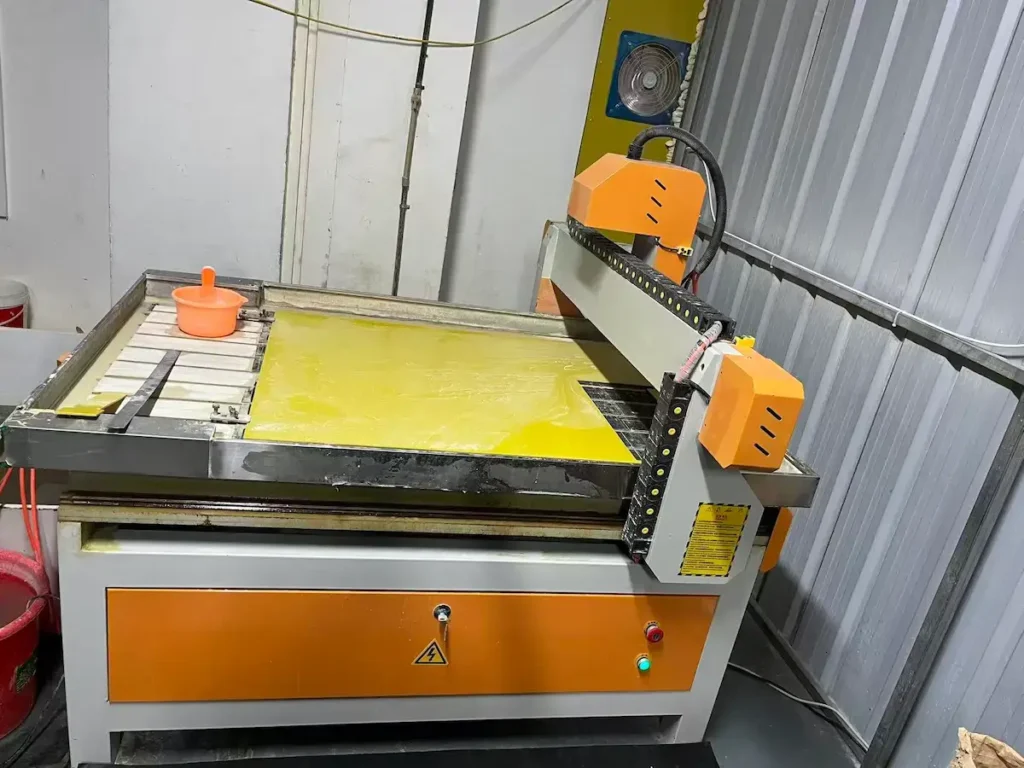 A CNC cutting machine in our factory, used to carve hard molds
 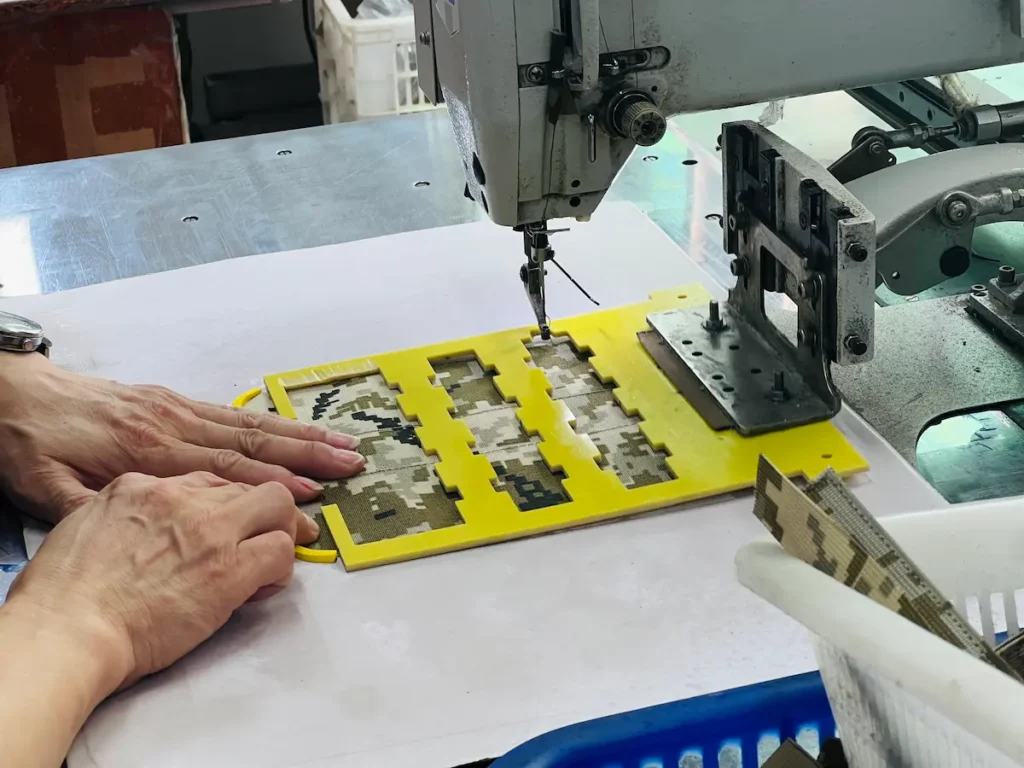 Industrial sewing machine with a yellow template, stitching camouflage tactical fabric during factory gear production
 Step 4: Conduct an Evaluation Process
Once you have a shortlist, a structured evaluation helps mitigate risk.
- The Factory Audit (Virtual or In-Person): Request a live video tour of the facility. Look for cleanliness, organization, quality control checkpoints, and in-house capability for key processes like cutting, sewing, and printing.
- The Sampling Phase: A transparent sampling process is non-negotiable. Expect to pay for this service. A standard process includes:
- Prototype Sample: To check design, fit, and function.
- Pre-Production Sample (PP Sample): Made with correct materials and construction, representing final quality.
- Evaluate Communication and Expertise: Assess whether your point of contact can discuss technical details—such as the difference between 500D and 1000D nylon, or the proper application of a ladder lock buckle—with authority. Clear, responsive communication during sampling is the best predictor of a smooth production run.
Step 5: Identify Key Red Flags and Green Lights
Discerning warning signs early can save substantial time and resources.
Common Red Flags:
- Unwillingness to sign a basic NDA or provide a formal contract.
- Prices are significantly lower than all other quotes, often indicating corner-cutting.
- Lack of curiosity about your tech pack or end-user.
- Inability to provide a clear timeline or reference for similar work.
Positive Green Lights:
- Proactive suggestions for design-for-manufacturability (DFM) improvements.
- Transparent cost breakdowns and clear payment terms.
- A documented quality control plan for mass production.
- Willingness to connect you with an existing client for a reference.

Conclusion: Building a Partnership for the Long Term
Finding the right manufacturer is ultimately about finding a credible partner invested in your product’s success. It requires due diligence, clear communication, and a focus on shared standards over short-term cost savings.
For brands seeking to streamline this complex process, partnering with an established manufacturer from the outset can be the most efficient path. With over 15 years of specialization in tactical and outdoor gear, we guide our clients through development, prototyping, and production with transparent communication and rigorous quality control.
If you are looking for a 전술 배낭 제조업체 to execute your vision with expertise, we are ready to provide a confidential project evaluation. 문의하기 to discuss your technical pack and requirements.

 콘텐츠로 건너뛰기